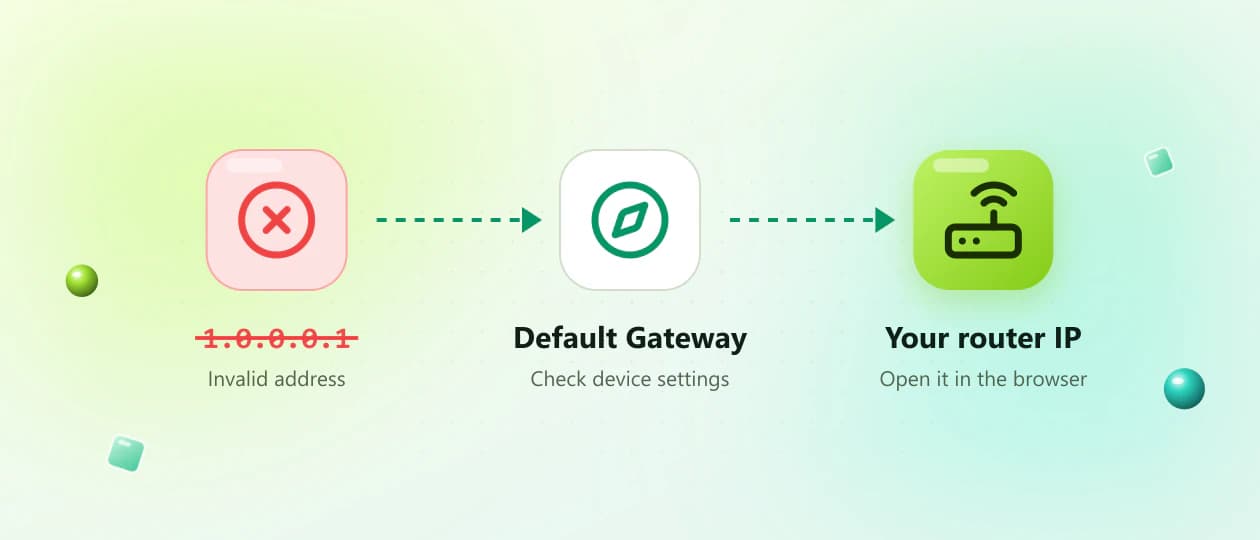
Invalid format · 5 blocks
1.0.0.0.1 IP Address – Valid Login or Typing Error?
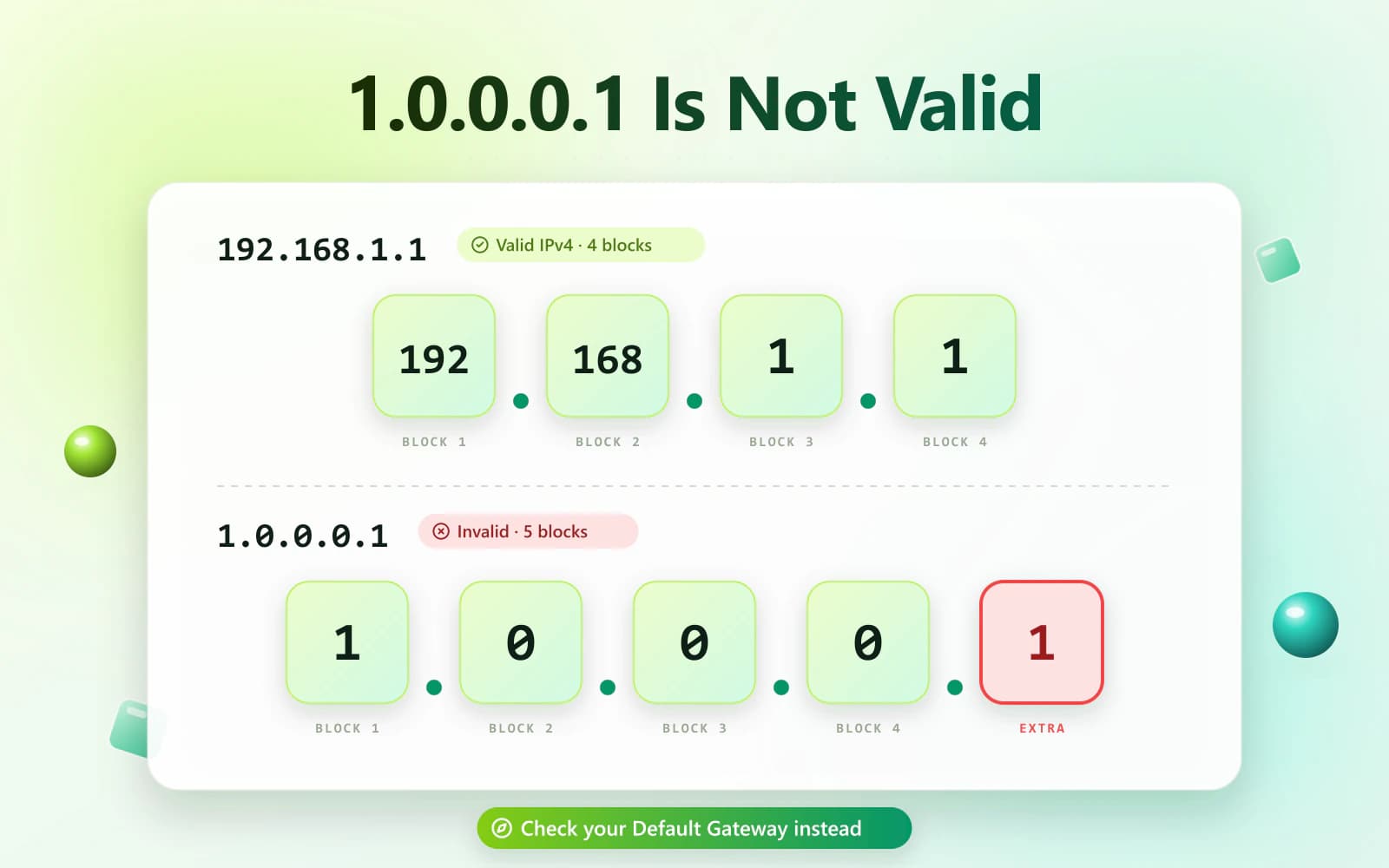
The 1.0.0.0.1 IP address might appear similar, to a router login address. 1.0.0.0.1 Is not a valid standard IPv4 address. 1.0.0.0.1 Has five number blocks while a standard IPv4 address uses four blocks.
Opens your router login page in a new tab. Works only on your own network.
- Not a valid standard IPv4 address
- Five number blocks

On this page19
Login options
Choose where to sign in
Pick what you are trying to open. Each button goes straight to that address on the network you are connected to.
Router admin login
http://10.0.0.1Wi-Fi name and password, connected devices and security settings on routers and cable gateways that use 10.0.0.1.
Open 10.0.0.1 for Router admin login (opens in a new tab)Router login (HTTPS)
https://10.0.0.1For routers that only accept a secure connection to their admin page.
Open 10.0.0.1 for Router login (HTTPS) (opens in a new tab)Piso WiFi portal & pause time
http://10.0.0.1Insert coin, check your remaining time and pause your session on a Piso WiFi network.
Open 10.0.0.1 for Piso WiFi portal & pause time (opens in a new tab)Not opening?Piso WiFi admin login
http://10.0.0.1/adminOwner settings for Piso WiFi machines, such as rates, vouchers and pause time.
Open 10.0.0.1/admin for Piso WiFi admin login (opens in a new tab)Username & password help
These addresses open on the network you are connected to. Nothing you type is sent to this website.
Overview
Did you mean 10.0.0.1 or 1.0.0.1?
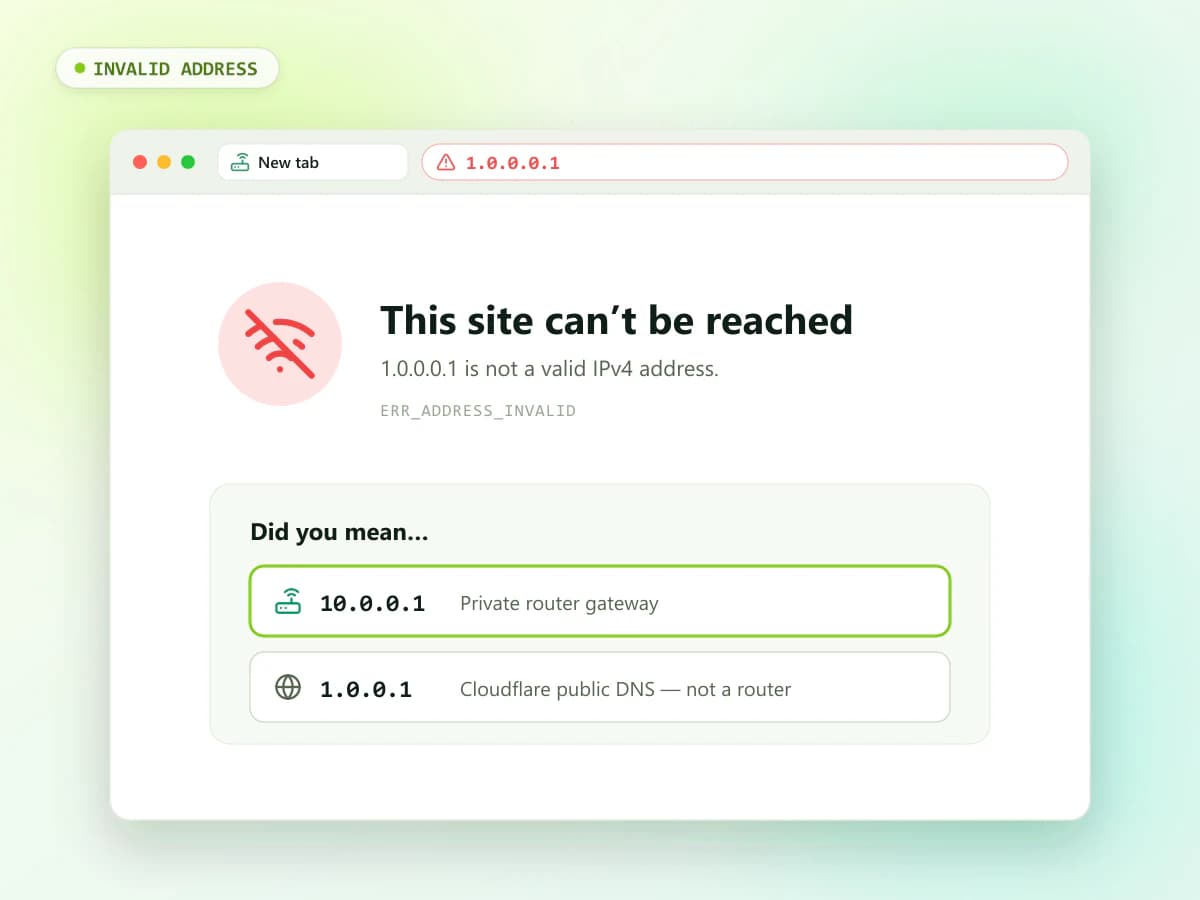
If you typed 1.0.0.0.1 while attempting to reach your router you might have intended 10.0.0.1. Many routers use 10.0.0.1 as their gateway and admin panel address.
Another address that looks similar is 1.0.0.1. However 1.0.0.1 belongs to Cloudflare’s public DNS service. Is not usually used for router login.
Quick Answer: Is 1.0.0.0.1 a Valid Login IP?
No 1.0.0.0.1 is not a standard IPv4 address or a confirmed router login IP. A normal IPv4 address is made of four number blocks separated by periods. 1.0.0.0.1 Has five blocks. Check your device’s network settings to find the Default Gateway instead of trying to reach 1.0.0.0.1.
The address
What Is the 1.0.0.0.1 IP Address?
Users often search for 1.0.0.0.1 login when they want to open their router’s admin panel. They might need to change the Wi‑Fi password update the network name or see which devices are connected.
However 1.0.0.0.1 is usually a typing mistake. It looks like real network addresses, especially 10.0.0.1 and 1.0.0.1.
Entering the incorrect address in a browser may:
- Display an invalid IP address error
- Open a search-engine results page
- Show a “This site can’t be reached” message
- Redirect you to an unrelated public website
- Produce a connection timeout
There is no standard router brand, admin page, username or password associated with 1.0.0.0.1.
IPv4 format
Why Is 1.0.0.0.1 an Invalid IP Address?
A standard IPv4 address contains four number blocks. These blocks are called octets and are separated by periods.
192.168.1.1
For example: This address contains four blocks:
- 192
- 168
- 1
- 1
Four blocks · valid1.0.0.0.1
Now consider 1.0.0.0.1:
- 1
- 0
- 0
- 0
- 1
Five blocks · invalid
The rule
Each block normally represents a number from 0 to 255
Each block normally represents a number from 0 to 255.
It contains five blocks. Therefore, it does not follow the standard four-octet IPv4 format.
The extra period is enough to make the address invalid. Removing or changing a period may also create a completely different IP address, so always verify the correct gateway before trying to log in.
Compare
Did You Mean 10.0.0.1 or 1.0.0.1?
People often confuse 1.0.0.0.1 with 10.0.0.1 or 1.0.0.1. Although the numbers look similar, these addresses have different purposes.
| Address | Valid IPv4? | Address type | Main purpose | Router login? |
|---|---|---|---|---|
| 1.0.0.0.1 | No | Invalid format | Usually a typing error | No |
| 10.0.0.1 | Yes | Private IPv4 | Local gateway on some networks | Sometimes |
| 1.0.0.1 | Yes | Public IPv4 | Cloudflare DNS resolver | Normally no |
1.0.0.0.1
- Valid IPv4?
- No
- Address type
- Invalid format
- Main purpose
- Usually a typing error
- Router login?
- No
10.0.0.1
- Valid IPv4?
- Yes
- Address type
- Private IPv4
- Main purpose
- Local gateway on some networks
- Router login?
- Sometimes
1.0.0.1
- Valid IPv4?
- Yes
- Address type
- Public IPv4
- Main purpose
- Cloudflare DNS resolver
- Router login?
- Normally no
Private IPv4
10.0.0.1 Router Login
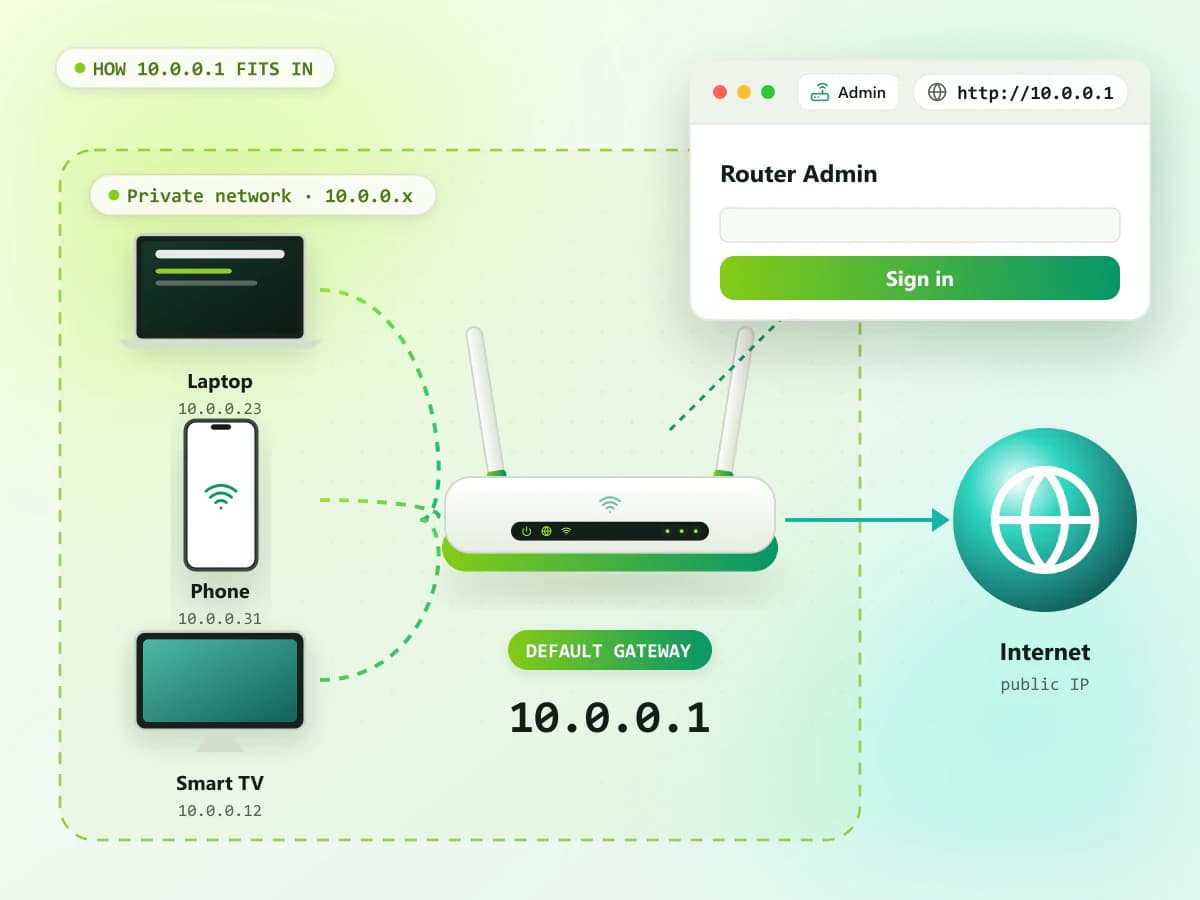
10.0.0.1 is a valid private IPv4 address. Some routers, modems and network systems use it as their local gateway.
If your router uses this address, you may be able to open its admin page by entering the following address in your browser: http://10.0.0.1
It will only work if 10.0.0.1 is the gateway assigned to your router. Other routers may use addresses such as:
- 192.168.0.1
- 192.168.1.1
- 192.168.1.254
- 10.0.1.1
Do not test random addresses. Check your connected device to find the correct gateway.
Public DNS
What Is 1.0.0.1 Used For?
1.0.0.1 is a valid public IP address operated by Cloudflare. It is used as a secondary address for Cloudflare’s public DNS resolver, alongside 1.1.1.1.
A DNS resolver helps your device convert website names into the IP addresses needed to reach those websites.
The 1.0.0.1 address is not normally a local router gateway. Entering it in a browser will not provide access to your home router’s settings.
Default gateway
How to Find Your Correct Router IP Address
Your router’s local address is usually shown as Default Gateway, Gateway or Router in your device’s network settings. Make sure the device is connected to the router through Wi-Fi or Ethernet before following these instructions.
Find the Router IP on Windows
- Press Windows + R.
- Type cmd.
- Select OK.
- Type ipconfig.
- Press Enter.
- Find the active Wi-Fi or Ethernet connection.
- Look for Default Gateway.
- The number displayed beside Default Gateway is normally your router’s IP address.
- For example: Default Gateway: 192.168.1.1
- Enter that exact address in your browser.
WindowsFind the Router IP on macOS
- Open the Apple menu.
- Select System Settings.
- Click Network or Wi-Fi.
- Open the details of your connected network.
- Select TCP/IP if required.
- Find the value beside Router.
- The Router value is the address you should use to open the admin panel.
macOSFind the Router IP on Android
Android menu names can vary by manufacturer.
- Open Settings.
- Tap Network & internet, Connections or Wi-Fi.
- Select your connected Wi-Fi network.
- Open Network details or Advanced.
- Find Gateway or Router.
- Do not copy the value labelled IP address. That is generally the phone’s local address rather than the router gateway.
AndroidFind the Router IP on iPhone or iPad
- Open Settings.
- Tap Wi-Fi.
- Connect to your router’s network.
- Tap the information icon beside the network name.
- Scroll down to the IPv4 section.
- Find Router.
- Use the address shown beside Router to access your network settings.
iOS / iPadOS
Step by step
How to Open the Correct Router Admin Page
After finding your router’s real gateway, follow these steps:
- 01
Connect your phone or computer to the router.
- 02
Temporarily turn off mobile data if you are using a phone.
- 03
Open Chrome, Safari, Edge or another trusted browser.
- 04
Select the browser address bar.
- 05
Enter the exact gateway address.
- 06
Press Enter or Go.
- 07
Wait for the router login page to appear.
- 08
Enter the authorized admin username and password.
Only access a router that you own or have permission to manage. Enter the IP address directly into the address bar. If you use a search box, the browser may show search results instead of opening the router panel.
Where to look
Default Gateway, Gateway or Router
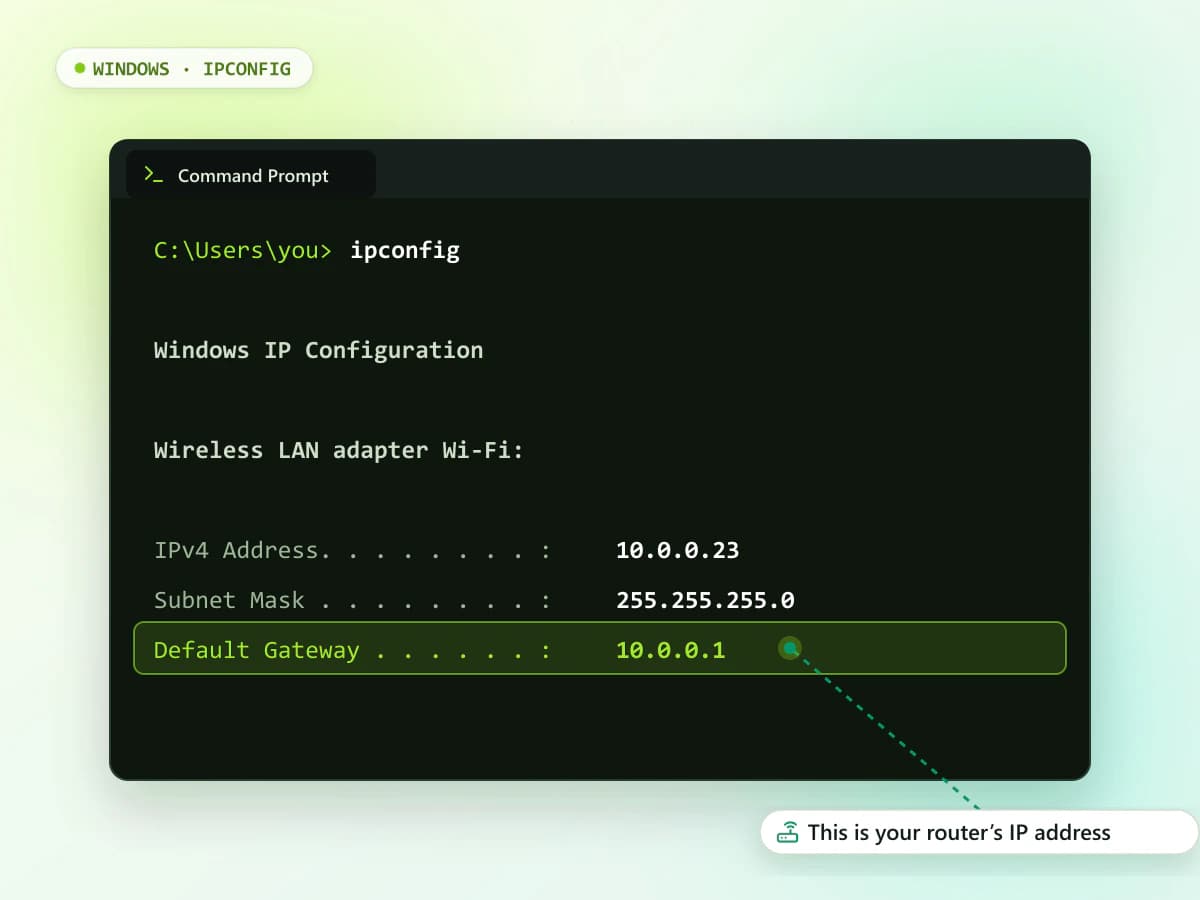
Default Gateway on Windows
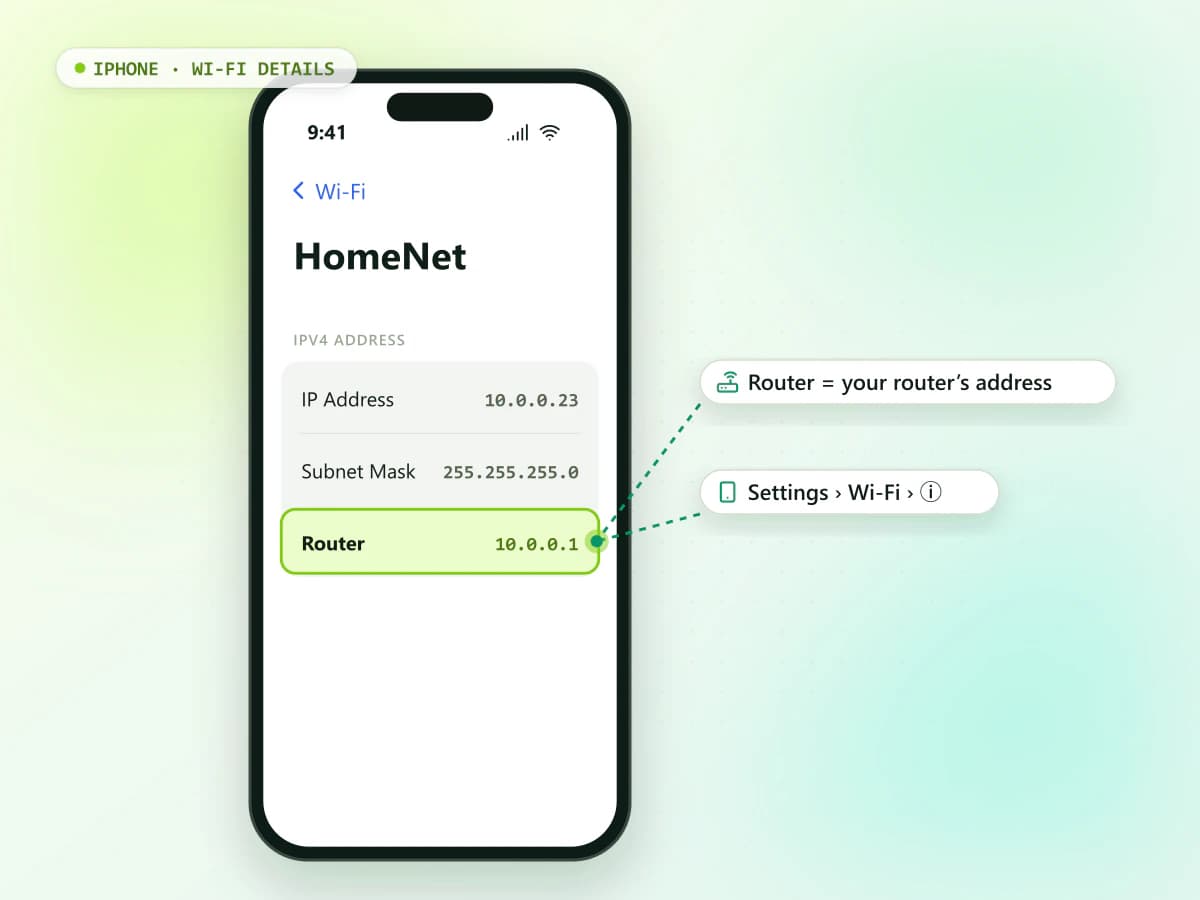
Router on iPhone
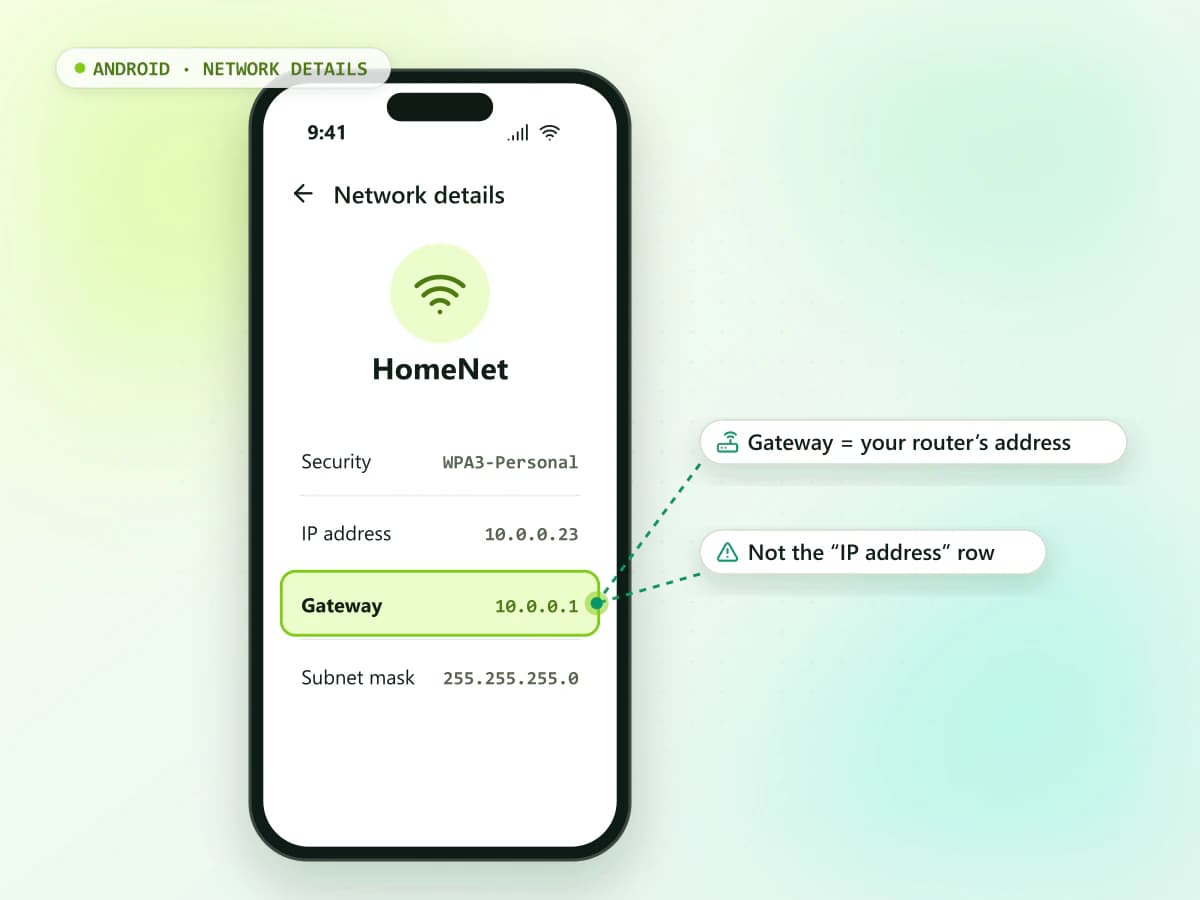
Gateway on Android
Credentials
Router Password vs Wi-Fi Password
The Wi-Fi password and the router admin password are not always the same.
The Wi-Fi password allows a phone, a computer or a smart device to connect to the network.
The router admin password provides access, to settings including:
- Wi-Fi name and password
- Network security
- Guest Wi-Fi
- Connected devices
- Parental controls
- Router firmware
- Advanced network options
If your Wi-Fi password does not work on the admin page, check the router label, manual or ISP documents for separate login details.
Troubleshooting
Why Is the Router Login Page Not Opening?
Even the correct router gateway may sometimes fail to load. Check the following common causes.
The Address Was Entered Incorrectly
Check for missing numbers, extra dots or spaces. These variations are not the same:
- 1.0.0.0.1
- 10.0.0.1
- 1.0.0.1
- 10.0 0.1
- 10.00.1
- Enter only the gateway shown in your device’s network settings.
Cause 01Your Device Is Using Mobile Data
A local router page usually works only when your device is connected to that router’s Wi-Fi or Ethernet network. Connect to Wi-Fi and temporarily disable mobile data before trying again.
Cause 02The Address Was Entered in a Search Box
Your browser may search the web if the IP is entered into a search field. Type it directly into the main address bar. You can add http:// before the verified gateway if necessary.
Cause 03A VPN or Proxy Is Active
A VPN or proxy can interfere with access to local network addresses. Pause it temporarily, open the router page and enable it again when finished.
Cause 04The Browser Has Stored Old Data
Try these simple fixes:
- Open a private or incognito window
- Clear the browser cache
- Use another browser
- Test the gateway on another connected device
Cause 05The Router Needs to Restart
Disconnect the router from power and wait around 30 seconds. Reconnect it and allow it to start completely before testing the gateway again. Do not press the reset button during a normal restart. A factory reset may erase your custom network settings.
Cause 06
Credentials
Where Can You Find the Router Username and Password?
Check the following places for the router’s admin login details:
- Label underneath or behind the router
- Original router box
- Setup manual
- Documents supplied by the ISP
- Browser’s saved passwords
- Password manager
- Manufacturer’s official support website
Some routers have unique passwords printed on their labels. Others ask the owner to create an admin password during initial setup. Do not assume that every router uses admin as its username and password.
Credentials
What If the Router Password Does Not Work?
First, confirm that you are using the admin password rather than the Wi-Fi password.
The default credentials may fail because:
- The admin password was changed
- The ISP configured custom credentials
- The wrong router IP was opened
- The username or password was typed incorrectly
- The router uses a unique password
- The login details are case-sensitive
Check saved passwords or ask the person who configured the network. A factory reset should only be used as a final option. It may remove the Wi-Fi name, password, ISP settings, guest network, parental controls and other custom configurations.
Wireless
Can You Change the Wi-Fi Password Through 1.0.0.0.1?
No. You cannot change Wi-Fi settings through 1.0.0.0.1 because it is not a valid standard router IP.
First, find your router’s real gateway. Open that address and sign in with the authorized admin credentials.
The Wi-Fi password setting may appear under:
- Wireless Settings
- Wi-Fi Settings
- WLAN
- Security
- Wireless Security
- Pre-Shared Key
Menu names vary between router brands and models.
Safety
Is It Safe to Enter 1.0.0.0.1?
Searching for this keyword is not normally dangerous. However, you should be careful if a public website claims to be the 1.0.0.0.1 admin panel.
Protect your router credentials by following these rules:
- Never enter admin credentials on an unrelated website.
- Check that the IP matches your real gateway.
- Do not download unknown router-login software.
- Use only official manufacturer resources.
- Access only a network you own or manage.
- Never share router passwords publicly.
- Leave pages requesting payment or personal information.
Browser privacy warnings on local router pages
I noticed that some legitimate local router pages may show a browser privacy warning because the device does not have a trusted HTTPS certificate. Before you continue, double‑check that you are connected to your router and that you are using the correct local gateway.
Typed it differently?
Common misspellings of 10.0.0.1
These are the most common ways the address gets mistyped in search. Enter the address in the right-hand column directly in the browser address bar.
| What was typed | What to enter instead |
|---|---|
| 1.0.0.0.1 | http://10.0.0.1 |
| 1.0.0.0.0.1 | http://10.0.0.1 |
| 10.0.0.0.1 | http://10.0.0.1 |
| 10.0 0.1 | http://10.0.0.1 |
| 10.00.1 | http://10.0.0.1 |
| 10.0.01 | http://10.0.0.1 |
| 10.0.0.01 | http://10.0.0.1 |
| 1.0 0.0 1 | http://10.0.0.1 |
| 10.0.0.1o or o.10.0.0.1 | http://10.0.0.1 |
| 10.0.0.1.1 | http://10.0.0.1 |
| 10.0.1 | http://10.0.0.1 (some Apple routers use http://10.0.1.1) |
| 10.0.0.1/admin typed into a search box | http://10.0.0.1/admin in the address bar (Piso WiFi admin) |
1.0.0.0.1
- What to enter instead
- http://10.0.0.1
1.0.0.0.0.1
- What to enter instead
- http://10.0.0.1
10.0.0.0.1
- What to enter instead
- http://10.0.0.1
10.0 0.1
- What to enter instead
- http://10.0.0.1
10.00.1
- What to enter instead
- http://10.0.0.1
10.0.01
- What to enter instead
- http://10.0.0.1
10.0.0.01
- What to enter instead
- http://10.0.0.1
1.0 0.0 1
- What to enter instead
- http://10.0.0.1
10.0.0.1o or o.10.0.0.1
- What to enter instead
- http://10.0.0.1
10.0.0.1.1
- What to enter instead
- http://10.0.0.1
10.0.1
- What to enter instead
- http://10.0.0.1 (some Apple routers use http://10.0.1.1)
10.0.0.1/admin typed into a search box
- What to enter instead
- http://10.0.0.1/admin in the address bar (Piso WiFi admin)
Only a device on your own network answers at 10.0.0.1. If the corrected address still does not open, check your Default Gateway first.
FAQ
1.0.0.0.1 Frequently Asked Questions
Is 1.0.0.0.1 a valid IP address?
No. A standard IPv4 address has four number blocks, while 1.0.0.0.1 contains five. It is generally a typing error.
Can 1.0.0.0.1 open a router login page?
No. It is not a valid standard router gateway. Check your device’s Default Gateway field or Router field to locate the address.
Is 1.0.0.0.1 the same as 10.0.0.1?
No. The address 10.0.0.1 is a valid private IPv4 address used by some routers. The five-block 1.0.0.0.1 address is invalid.
Is 1.0.0.0.1 the same as 1.0.0.1?
No. The address 1.0.0.1 is a public IP. I have found that the address 1.0.0.1 is connected to Cloudflare’s DNS service. . It is not normally a home-router login address.
Why is 1.0.0.0.1 not working?
The address 1.0.0.0.1 does not follow the IPv4 format. Because of this your browser might reject 1.0.0.0.1 start a web search or show a connection error.
How do I find my router IP?
You should open the network details on a device that is already connected. Then look for the value labelled Default Gateway, Gateway or Router to find your router IP.
Where can I find the router admin password?
You can check the router label, the manual, the box, ISP documents or the manufacturer’s official support page to find the router admin password. Please keep in mind that the original router admin password might not work if someone changed the router admin password before.
Can I change my Wi-Fi password using 1.0.0.0.1?
No. Find your router’s correct gateway, sign in with authorized admin details and open the wireless security settings.
Conclusion
The 1.0.0.0.1 IP address is not a standard IPv4 address and is not a confirmed router login gateway. It is probably a mistake when typing 10.0.0.1, 1.0.0.1 or another local address. Of making assumptions look at the Default Gateway or Router field on a device that is connected to your network. Type that address, into the browser and use the admin details that belong to your own router.